We’ve been chasing spotted coralroot this summer with no luck, so it was high on our list of what we hoped to see when we headed north this past weekend. We even had coordinates for places where it had been seen blooming recently. Surely this time we would find it.
We’ve found several populations of the similar-looking Western spotted coralroot. And while they are different flowers, they are also close look-alikes, and telling them apart can be challenging. We’ve finally learned to look closely at the lower lip of the tiny 1/2 inch flowers–western spotted coralroot’s lip flares out at the bottom while spotted coralroot’s lip is more rectangular, a difference that takes close examination.
Stop after stop, as we drove up the north shore, our luck for finding flowers on our want-to-see list ran strong: American beach grass on Point Pine Forest, berries on female Canada buffaloberry bushes farther north, lesser purple fringed orchid in a ditch farther north still. A hike up to Bear and Bean Lake led us past our first-ever pinesap, and in Taconite harbor we found early saxifrage leaves that we’ll return to earlier next year to try to catch in flower.
All along the way, as we drove down roads and hiked down trails, as we followed GPS coordinates to impossible-for-us-to-bushwhack-through thickets, we searched for spotted coralroot without luck. We found several bunches of western spotted coralroot and one pale yellow coralroot that looked so much like autumn coralroot we checked to see if autumn coralroot grew that far north. It doesn’t. Perhaps this was a yellow version of western spotted coralroot? We didn’t know, we only knew it wasn’t the spotted coralroot we were searching for. More days, more miles, more stops, more flowers. But no spotted coralroot.
On our last morning we had one final stop to try. All we needed, we told ourselves, was one spotted coralroot in bloom. Just one.
And one is what we found, blooming alongside a trail at Savanna Portage State Park. Close examination revealed that yes, the flower lip was square. Yes, it was spotted coralroot. Cheers (and photographs) ensued.
Chasing wildflowers, we live in hope. After three days and 740 miles seeing even more native wildflowers than we could have imagined, including the elusive spotted coralroot, we drove happily, hopefully home.
American beach grassCanada buffaloberryLesser purple fringed orchidPinesapEarly saxifrageWhat coralroot?What coralroot?Western spotted coralroot in seedSpotted coralroot
We’ve been looking for specific flowers blooming in specific places when our two different schedules allow, which only works when the flowers cooperate. This year when bloom times seem less predictable than usual, we’ve come to expect disappointments along with successes, so this past weekend in the absence of flowers to count we started counting disappointments.
Disappointment number 1: The roadside where we’d seen showy milkweed blooming last summer shows no signs this year of showy, or of almost any other, milkweed. Where did they go? We don’t know. We only know they aren’t where we’d seen them before.
Disappointment number 2: The tessellated rattlesnake plantain leaves and last year’s flower stalks that we’d seen in Badoura Jack Pine Woodland Scientific and Natural Area (SNA) last fall are nowhere to be found, even though we scour the area around the GPS coordinates we’d recorded and brought with us.
Disappointment number 3: We are almost at Iron Springs Bog SNA when the low tire pressure light comes on. Do we change plans and drive forty miles to the nearest town large enough to have a tire store, or do we fill the tire up with air and take a chance it will hold while we explore the SNA? We take a chance, inflate the tire, and head to Iron Springs Bog. But we’re barely down the rutted, slippery track into the SNA and beginning our search for an adder’s mouth orchid when the sky darkens, thunder threatens, and lightning crisscrosses the clouds.
We run for the car and make it back up the treacherous track just as rain sluices down so hard we can barely see the road. We make it to town, where we look so forlorn that the manager at Tires Plus works us into his crowded schedule and patches our tire. We find our hotel, and settle in for the night.
The next day is sunny and fresh-washed, and so are we. Back at Iron Springs Bog, we search for an adder’s mouth along with other orchids we’ve seen there. Hours pass without success, but the bog is rich and green after the rain, moss is soft underfoot, and the tall slender bog orchids platanthera aquilonis* and platanthera huronensis* are plentiful. We find one showy lady’s-slipper with a single flower and the leaves of several more plants, their blossoms nipped off by whatever eats these elegant flowers. Just as we are about to drive on we find one more orchid with a few small flowers that we identify as a blunt-leaved orchid. Not seeing any sign of the orchids we came to find might count as disappointment number 4. But on such a splendid morning, do we care? We do not.
Our next stop takes us to Larix Wildlife Management Area (WMA) where we’ve heard we might see some rare flowers. We park at the corner, begin to bushwhack in through the dense undergrowth and trees, and quickly realize how easily we could get very, very lost. Luckily we’ve brought plastic marking tape so we can boldly go where no one seems to have gone in a very long time, marking our way with orange strips tied to trees. When we finally admit that we are only getting into more unpassable bushwhacking we backtrack, taking our orange ties with us. But we agree that not getting lost counterbalances the disappointment of not really getting anywhere at all.
Across the road lies Gully Fen SNA, looking almost as densely impenetrable as the WMA we’ve just left, but we decide to at least drive around the edges. About halfway around we come to a gate and a sign that says, “Stay on the Trail.”
Trail? We park and hike easily and gleefully into the SNA where we spy wood lilies, blue flag, shrubby cinquefoil, and pink shinleaf. We’ve barely scratched the surface of Gully Fen’s 1600 acres before it’s time to start the long drive home, but we promise to come back with much more time to explore this amazing place.
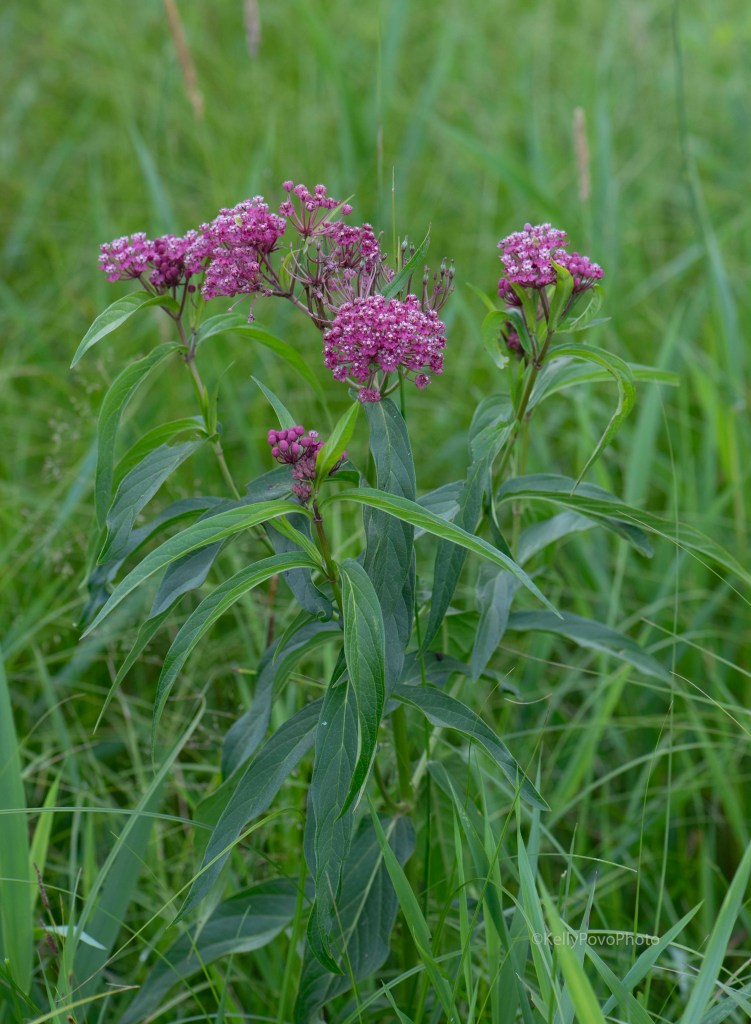
One last turn down a road along the edge of the SNA takes us past a roadside ditch with a small stretch abloom with wood lilies, Joe Pye weed, swamp milkweed, goldenrod, yarrow, Kalm’s lobelia, and, amazingly, many platanthera aquilonis orchids. We’ve looked hard in many places, but this gift of a ditch feels like the richest place we’ve seen all weekend.
Flowers may not bloom when and where we expect them to, disappointments may occur, but always we see unlooked-for wonders that make our hearts happy and grateful.
What more could a flowerchaser want?
*Note: Usually we use common names for flowers, but the similar orchids platanthera aquilonis and platanthera huronensis share so many variations of the same common names (tall, northern, bog, green) that we decided we needed to learn their scientific names to keep them straight.
Because we are in the midst of another book, our wildflower chasing trips this summer have been focused mostly on specific flowers we want to include in the new book. This means heading out to particular places at times we are able to go and hoping the plants we want to see will cooperate by blooming where we can find them. Alas, not always true, but even when we don’t have total flower chasing success, we sometimes find unlooked-for surprises.
This past weekend we headed north with a laundry list of places to stop and plants we need to see, but as we made our way up the north shore we checked off stop after stop without checking off any flowers that we needed.
Then we came to a section of Lake Superior shoreline where we’d been told we might see arctic relicts. We made our way down the rocks, careful of where they dropped off steeply and of the slippery places where, even in this dry year, water seeped toward the lake. In one damp spot, a splendid surprise: Canadian tiger swallowtail butterflies puddling on the rock, flitting down to the moisture, sipping, flying away to return for another drink.
Butterflies weren’t the only surprise. In cracks of the rocks and in places where the water pooled we found common butterwort (so much that we understood how it got its name, since we’ve only ever seen it uncommonly in Minnesota before), bird’s-eye primrose with some flowers still blooming, three-toothed cinquefoil flowering, and round-leaved sundew gleaming redly in the moss. We wandered from tiny habitat to tiny habitat, marveling that high on these rocks a small relict world survived.
Then back to the road and more stops. By the end of the day we had checked off a few finds: western spotted coralroot, small false asphodel, Canada buffaloberry. We’d found several places we hoped to return to again when flowers might be more cooperative. We’d found a sweet little habitat of plants thriving in their own world. And we had spent the day in the presence of Lake Superior.