Winter Wildflower Dreams

February 23, 2022

Author: Phyllis Root
Photographer: Kelly Povo

Last year we went looking for wildflowers in the snow—and found some.  (To be accurate, on a winter hike we recognized leaves and stems as former and future wildflowers).  But winter is not high wildflower season, so until skunk cabbage pokes its pointy nose through the snow, we are busy thinking wildflower garden thoughts.

In the heart of winter we dream wildflower dreams. 

Both of us have been planting native wildflowers in our yards over the years.  Some flowers we plant for pollinators, especially the federally endangered rusty-patched bumblebee. Some we plant for their beauty. Some we plant with hope that never blooms (neither do the flowers).  Some plants do well, some don’t, and for some the verdict is still out. But still we plant.

Here are some of our successes, in shade and in sun, and some of the plants on our wish list for this year’s garden.

FLOWERS IN THE SHADE

Under the shade of leafing trees we plant spring ephemerals and other early flowers that bloom before the trees leaf out completely and block the sun.  Ephemerals disappear once they’ve flowered, while other spring bloomers keep their stems and leaves.  All of them brighten the time when we’re hungriest for color, and bumblebee queens are hungriest for nectar and pollen after their long winter. All of our garden flowers are from seeds, from native plant nurseries, or from generous friends’ gardens.   

Virginia bluebells
Spring beauty
Smooth Solomon’s seal
Wild ginger
Bloodwort
Bishop’s cap
Large-flowered trillium
Jack-in-the-pulpit
Mayapple
Large-flowered bellwort
Red columbine


FLOWERS IN THE SUN

If spring and shade mostly belong to the woodland flowers, summer belongs to the prairie.  A few prairie flowers are early bloomers—pasqueflower blossoms even in the snow, and prairie smoke is another early flower—but most of our prairie garden celebrates summer. Bees, butterflies, even hummingbirds appreciate these flowers, and so do we.   We’ve had to be firm with some of our favorite flowers that want to spread themselves everywhere, but even overachievers have a place in our pockets of prairie. Here are some of our better-behaved successes, some from native plant nurseries or friends, some from seeds.

Spiderwort
Prairie shooting star
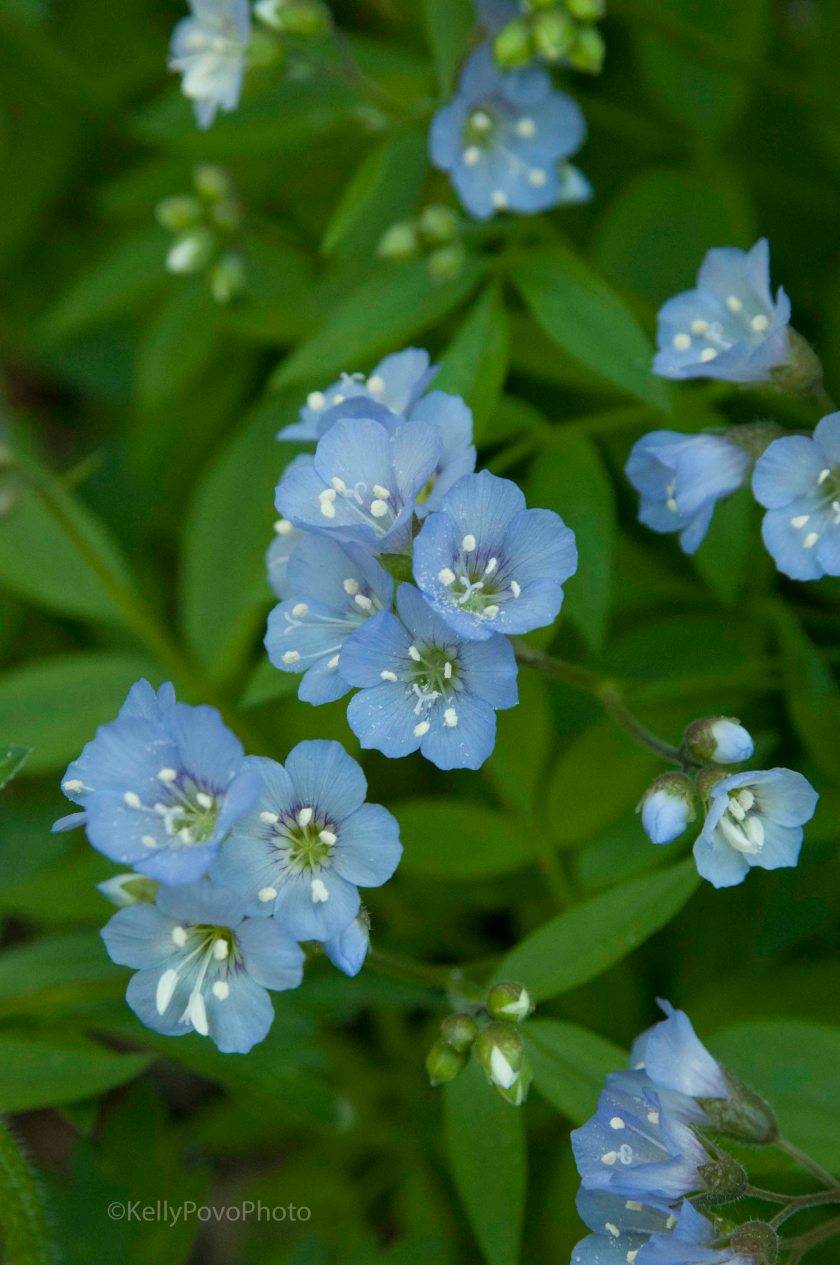
Spreading Jacob’s ladder
Butterflyweed
Prairie blazing star
Rough blazing star
Narrow-leaved purple coneflower
Purple prairie clover
Bottle gentian
Rattlesnake master
Wild bergamot
Blue giant hyssop
Rough blazing star
Pasqueflower
Prairie smoke
FLOWERS FOR NEXT YEAR’S GARDENS

Every year we love our gardens, and every year we dream about next year’s gardens.  Here are some native wildflowers we hope to find a place for once winter has melted away. 

Dutchman’s breeches
Large-flowered penstemon    
Halberd-leaved rose mallow
Cardinal flower
Sharp-lobed hepatica
Yellow star grass
Prairie blue-eyed grass
Wild sweet William
Twinleaf
Squirrel corn
Wild lupine 
Goat’s rue

Come spring, we’ll eagerly watch this year’s gardens sprout and bloom. And we’ll eagerly be out searching for native flowers wherever we find them. We hope you will, too. Happy gardens and happy searching from two native wildflower chasers.

Hope

January 15, 2022

Author: Phyllis Root
Photographer: Kelly Povo

Since December 31, 2000, we’ve sat down together with notebooks to make a list of goals for the coming year.  The following January, we get out the notebooks, look at which goals we’ve accomplished (or haven’t), and make a new list for the coming year.  Last year’s list of 2021 goals for each of us began with HOPE, and this year’s goals for 2022 begin the same way: HOPE.  

In a way, just making a list of goals, especially in hard times, is an act of hope. Some of this year’s goals involve working for racial justice, some involve our jobs, some involve family and other folks we love.  

And many of our goals involve wildflowers.  

Here, while cold grips our state and snow buries the ground, are our hopes for flower chasing this year:

We hope this is the year we see ball cactus in bloom.
We hope to finally find bog adder’s mouth.
We hope to go to the North Shore and see encrusted saxifrage and auricled twayblade.
We hope to visit lots of bogs, including our favorite floating bog at Long Lake Conservation Center.
We hope to see Great Lakes gentian and pleated gentian in bloom.
We hope to see northern slender ladies’-tresses.
We hope to see brittle prickly pear in bloom.
We hope to see all the orchids we haven’t seen yet, (only four more to go) that are possible to see in Minnesota.
We hope to keep chasing native wildflowers and spreading the word about them.

Most of all, we hope.

Winter Wildflower Warmth

November 30, 2021

Author: Phyllis Root
Photographer: Kelly Povo

As November rolls into December with unseasonably mild weather, we’re looking back at the past summer and forward to what we might find when we search for the desiccated leaves and stems of last year’s flowers that we happened upon last December protruding above the snow (the flowers and leaves protruding, not us).

This past year we’ve been obsessed with finding as many as possible of Minnesota’s native orchids. On one trip we had an eight-orchid day, and on another trip when we visited Wisconsin with a knowledgeable friend we saw at least twelve different kinds of orchids in a single day. We’ve had to learn the scientific names of Platanthera orchids because we were tired of being baffled by whether we were looking at a tall green orchid, a tall bog orchid, a green bog orchid, a tall northern orchid, a tall green northern bog orchid, or any other combination of these common names, all of which have been used to describe both Platanthera huronensis and Platanthera aquilonis. Now we simply nod knowingly and say, “That’s a robust huronensis,” or “That is such a beautiful, delicate aquilonis.” Similarly, we were puzzled as to why the lesser round-leaved orchid (sometimes called the large round-leaved orchid) was much bigger than the round-leaved orchid. Now, whether other folks think of it as lesser or larger, we know it as Platantera orbiculata.

Of the 48 orchids native to Minnesota, we saw 37 in 2021. Many of them we’ve seen before 2021, but many others were new to us. We’ve given up hope of finding a couple of orchids that only grow in a few places or that are most likely extirpated from the state, but we were excited to learn that auricled twayblade, which we thought was a lost cause, grows in what will soon be a new Scientific and Natural Area on the North Shore. Now, auricled twayblade is at the top of the list for next year’s searches, along with the ever-elusive bog adder’s mouth.

We’ve also fallen in love with cedar swamps, where we’ve found bluntleaved orchid, lesser rattlesnake-plantain, calypso, green adder’s-mouth, ram’s-head lady’s-slipper, dragon’s-mouth, heart-leaved twayblade, round-leaved orchid, and striped coralroot.

Even though winter will soon be upon us, thinking about the wealth of wildflowers we’ve seen this past year (and the sometimes sweat-dripping weather we’ve searched for them in) will keep us warm in the frigid months ahead.

P.S. If you are looking for some wildflower winter warmth, too, be sure to stop by our annual holiday show this weekend and check out Kelly’s wildflower photos, Phyllis’s picture books including the most recent, Begin with a Bee, and our 2018 book, Searching for Minnesota’s Native Wildflowers. Bonfire, wine, and nummy noshes included! We hope to see you! (See invite below or email kelly@kellypovo.com for more information!)